
Handling Guest Requests at 3 AM Without Night Staff
2:30 AM. A guest can't connect to the WiFi. They walk down to the front desk. The counter is empty, closed since 10 PM. They call the internal number. Nobody picks up. They go back to the room, try to figure it out themselves. After an hour, they give up and fall asleep frustrated.
A week later, a review appears on Booking: two stars. "When we needed help, nobody was there. The hotel closes reception in the evening and guests are left on their own."
This scenario repeats itself in many small hotels and guesthouses. A night front desk means an additional position, often two (weekends, holidays). Salary, benefits, night shift premiums. For a hotel with 20-30 rooms, that cost has to be weighed against the real volume of night requests, escalations, and emergencies. Guests do not care about your HR budget. They need help when they need help. Including at three in the morning.
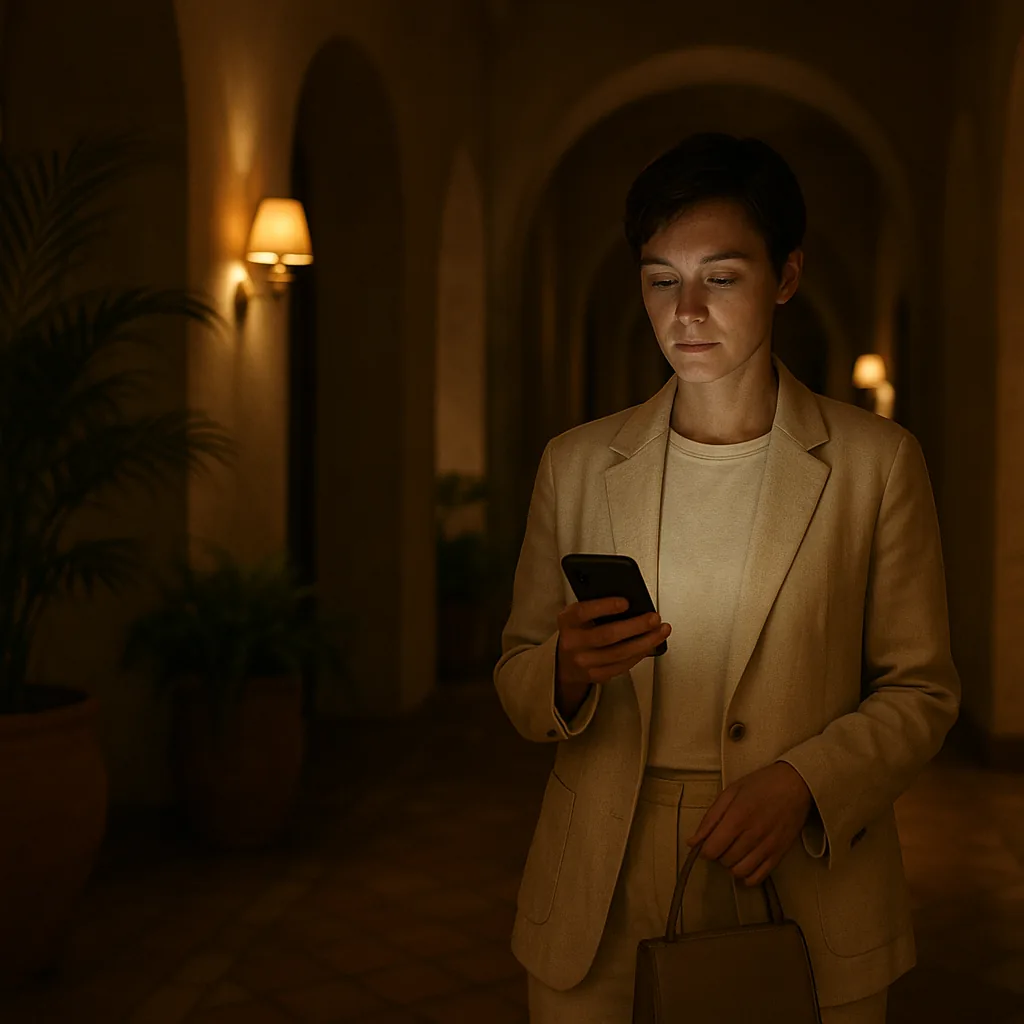
What Happens After Reception Closes
Let's compile a list of situations that happen after front desk hours. None of them are dramatic, but each one is a potential source of frustration and a bad review.
WiFi doesn't work. By far the most common nighttime issue. The guest changed rooms, the phone picks up a weak signal, the password doesn't work. Without technical help, the guest goes without internet until morning.
Noisy neighbors. A party in the next room at 2 AM. The guest wants to report it, but reception is closed. They knock on the neighbor's door themselves (which rarely ends well) or lie awake waiting for things to quiet down.
Air conditioning or heating. The room is too hot or too cold. The remote doesn't work or the guest doesn't know how to operate it. They need someone to help, or at least an instruction manual.
Breakfast questions. "What time does breakfast start? Can I order it to the room? I have an early flight, can I eat at 6 AM?" Simple questions, but if there's nobody to ask, the guest either guesses or gives up.
Lost key card. The guest came back from dinner and can't get into the room. The only option is to wait until morning or call the owner's personal number (if they even have it).
Early morning taxi. A 7 AM flight, the guest wants a taxi at 4:30 AM. If reception were open, they'd have asked in the evening. But they forgot. Now it's 1 AM and they don't know which number to call for a cab.
Each of these situations is solvable. The problem is that without any communication channel, the guest has no way to reach a solution.
The Cost of No Service at Night
The cost is hard to measure directly, but easy to see in three areas.
Reviews. Opinions mentioning unavailable staff ("nobody was there," "we couldn't reach anyone," "reception was closed") are among the most damaging reviews a hotel can receive. They don't talk about a dirty towel or street noise. They say the hotel doesn't care about its guests. That's a blow to credibility, not a complaint about a detail. A potential guest reading that review draws one conclusion: this hotel will leave me stranded.
Lost revenue. The guest who wanted to order a taxi through the hotel (commission). The guest who would have asked about a late checkout (extra charge). The guest who would have ordered a room-service breakfast for an early morning (additional restaurant revenue). All of these transactions require communication that doesn't exist after reception closes.
Liability. Information about emergency numbers, the nearest hospital, and evacuation procedures must be accessible 24/7. If a guest has a medical emergency at night and doesn't know which number to call or where the nearest emergency room is, the hotel has a serious problem. Not just a reputational one.
Self-Service: Give Guests Info Before They Ask
Let's start with the simplest solution. Most nighttime questions have predictable answers. WiFi password, breakfast hours, checkout time, emergency numbers, local taxi number, address of the nearest hospital. This information doesn't require a live person. It requires a place where the guest can find it at any time.
A guest portal accessible through the phone browser handles the simplest nighttime situations without pulling in the front desk. The guest opens the same link they got at check-in and sees: WiFi password, connection instructions, breakfast hours, hotel policies, emergency numbers, local restaurants and attractions, instructions for operating the air conditioning.
None of this information is secret or complicated. But if it's only available in a folder at the front desk (locked for the night) or on a card in the room (in the local language, while the guest is from another country), it's useless.
A digital portal with automatic translation handles both issues at once. Information is always available and in the guest's language. It's a basic solution, but it removes part of the reason guests look for reception at night.
AI Concierge: Answers at 3 AM
The portal covers questions where the answer is static information. But sometimes a guest needs more than data. They need advice, instructions, a solution to a problem.
"The AC remote isn't working, what should I do?" "Where's the nearest pharmacy open at night?" "Can I request a late checkout?" "I have a food allergy. Is there gluten in the breakfast?"
FAQ pages can't handle these. But an AI concierge can use the hotel's data, the neighborhood, the policies, and the menu to answer in the guest's language.
Does this replace a human? Not fully. It handles repeatable questions that a static FAQ cannot cover and escalates the rest to live chat or staff workflows.
For the cases that need a human, live chat with push notifications keeps the handoff visible. The guest sends a message. If the AI concierge can't help, the message goes to the manager or responsible staff member as an alert. The response-time expectation should be set by the hotel's staffing model, not by the software copy.
When You Actually Need a Human
I'm not going to pretend technology solves everything. There are situations where a human being physically present is necessary.
Medical emergencies. A guest has fainted, a child has a 104-degree fever, someone fell down the stairs. No chatbot can handle this. The guest needs someone who will call an ambulance and open the doors for paramedics.
Security concerns. Someone trying to break into a room, a guest feeling threatened, a fight in the hallway. This requires intervention.
Major infrastructure failures. A burst pipe, a power outage across an entire wing, water pouring from the ceiling. A maintenance person needs to come in.
But notice: these situations are rare. In a 30-room hotel, a genuine nighttime emergency happens maybe once a month. Maybe less. Maintaining a full-time night front desk for a situation that occurs 12 times a year is like buying an ambulance in case you catch a cold.
The solution: an automated alert system. The guest reports a problem through the portal or chat. If it's urgent (for example, they mark it as "emergency" or the system detects relevant keywords), the manager gets a push notification on their phone. Combined with emergency numbers available on the portal, the guest has a clearer path to help than a closed reception door.
This isn't a perfect solution. Perfect would be a 24-hour front desk. But for a hotel that can't afford one, the combination of self-service, AI, and alerts is a more transparent fallback than a closed reception door and silence on the other end of the line.
Conclusion
Small hotels don't need a night front desk to provide 24/7 guest service. They need the right combination: self-service information on the portal (WiFi, hours, emergency numbers), an AI concierge for questions that go beyond FAQ, and automated alerts to the manager's phone for situations that need a human.
A guest who finds the WiFi password on the portal at 2 AM won't write a bad review. A guest who couldn't reach anyone at 2 AM will. That difference comes down to having the repeat answers configured in the portal, not another full-time night shift position.
Written by
Denis Wasilew
Co-founder
Co-founder of Guestivo. Building scalable solutions that empower hotels to deliver outstanding digital guest experiences.
Published: March 10, 2026