
World Hotel 2026: Lessons From 100+ Hoteliers
On March 10–12 we exhibited at World Hotel 2026 at Ptak Warsaw Expo, the largest hospitality trade fair in Poland. Over 500 exhibitors, thousands of visitors from 22 countries, 50,000 square metres of exhibition space.
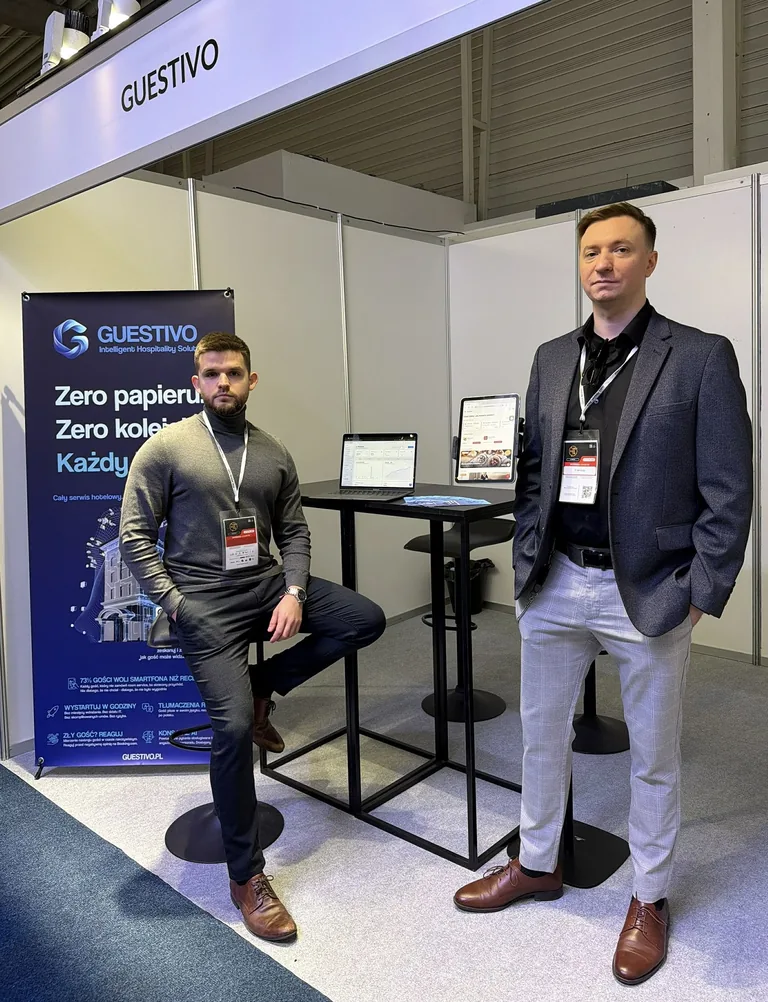
We had a booth, a screen with a live demo, and three days of conversations with people who run hotels every day. We had over 100 of those conversations. Not polite business-card exchanges, but substantive discussions about problems, tools, and guest expectations.
Some of the takeaways surprised us. Here's what we saw at the expo and what it says about the direction of the Polish hospitality market.
Software Among Furniture
Most exhibitors at World Hotel sell physical products: furniture, textiles, ventilation systems, kitchen equipment. We showed up with software. An interesting contrast that worked in our favour.
When people walked past and saw an app interface on screen instead of a physical product, they stopped out of curiosity. "So what do you actually do?" We heard that dozens of times. And every time, two minutes into the demo, the conversation shifted from polite to engaged. Because we were showing a solution to a problem they deal with daily.
The physical format of a trade fair turned out to be a great environment for presenting a digital product. People could pick up their phone, scan a QR code, and see the guest portal live. They could tap, order from the menu, send a message to chat. What's a screenshot on a website became a hands-on experience at the expo.
What Visitors Were Most Interested In
We had a full set of features to show, from food ordering and housekeeping to analytics and reservation management. But five things kept people at our booth the longest.
The no-app approach. This was hands down the number one topic. When we said the guest doesn't need to download anything, that they get a link by email at check-in or scan a QR code and everything works in the browser, we could see relief on managers' faces. "Finally someone who understands that guests don't want to install another app." We heard variations of that probably twenty times.
Live chat with sentiment analysis. When we showed that the system analyses guest mood in real time and can automatically alert the manager when someone is unhappy, it made an impression. Several managers immediately asked: "Does it really work in Polish?"
AI Concierge. A chatbot that knows the hotel's menu, policies, neighbourhood, and answers guests 24/7 in their language. For hotels with multilingual guests, this hit the mark. One mountain hotel owner said: "My reception closes at 10 PM. After that, guests have nobody to ask about anything."
Digital locks (Seam integration). Mobile access where the property has a supported lock system and the integration has been scoped. This attracted owners of newer properties in particular, who already have electronic locks but have no way to integrate them with the guest portal.
Real-time updates. Push notifications, live operations view. Reception sees an order the second it's placed. Housekeeping updates a room status and reception sees it instantly. For many visitors this was a sharp contrast with their current tools, where you have to refresh the page or pick up the phone.
Conversations That Surprised Us
We came to the expo with certain assumptions. Some held up. Others completely didn't.
Smaller properties were more open than big chains. We expected mid-size and large hotels to be our primary audience. In practice, owners of guesthouses, boutique hotels, and properties with 20–50 rooms showed the most interest. Why? They don't have an IT department, don't have a budget for a full-scale hotel management system, yet their guests expect the same level of digital service as in big chains. That's exactly the gap we fill.
PMS integration came up in every third conversation. "Does it integrate with our system?" That was the refrain of the expo. We used the opportunity and met with several PMS providers present at the fair to discuss deeper integrations. Those conversations are already underway.
Many hotels still run on paper. Not figuratively. Literally: notebooks, paper slips, Excel spreadsheets for room service orders. In 2026. This isn't criticism, it's an observation that shows the sheer potential for digitalisation in the Polish hospitality market.
Hoteliers want AI, but practical AI. Nobody asked about "artificial intelligence" as a buzzword. They asked: "Will it automatically translate my menu?", "Will this chatbot really answer a guest at 3 AM?", "Will sentiment analysis tell me before a guest leaves a bad review on Booking?" Concrete questions, concrete problems.
What We Learned About the Market
Three days on the expo floor is an intensive market course that no report can replicate.
The Polish hotel market is hungry for modern tools. But not in the "we want technology for technology's sake" sense. Rather: "we want solutions that work out of the box, don't require IT training, and cost a reasonable amount." That's exactly what we're building, but it's good to hear it directly from the people who run these hotels every day.
The barrier to entry isn't price, it's changing habits. Almost nobody complained about our pricing. Concerns were more along the lines of: "Will my staff learn this?", "Will older guests manage?", "What if the internet goes down?" These aren't technical concerns, they're human concerns. And they deserve to be taken seriously.
The integration landscape is fragmented. Every hotel has a different PMS, a different lock system, a different payment provider. There's no single standard. That's both a challenge (you have to build many integrations) and an opportunity (whoever builds them best, wins).
Expo isn't sales, it's validation. We didn't go to World Hotel to close deals. We went to check whether what we're building meets real market needs. The answer? Yes. Not with everyone, but with enough people for us to know we're heading in the right direction.
What's Next
We're back from the expo with a full CRM and a dozen-plus conversations we're continuing this week. Several of them are potential pilots, properties that want to implement Guestivo and see how it works in practice.
PMS integrations we discussed at the fair are entering the technical phase. That's the direction the market is clearly pulling us in, and we intend to follow through.
But the most important thing we're taking away from World Hotel is the confidence that we're building something the market needs. Not in theory, not according to reports. According to people who run hotels every day and see that their guests expect something better than calling the front desk.
If you were at the expo and we spoke, we'll be in touch. If we didn't get a chance to talk in the crowd, reach out to us. We're happy to continue the conversations we had at the booth online.
Conclusion
Over 100 conversations in three days. Dozens of concrete problems we have concrete answers for. And one confirmation that no report can provide: a digital guest portal isn't the future of hospitality, it's the present that a large part of the market hasn't implemented yet.
We'll be back at World Hotel 2027. With a bigger booth.
Written by

Maciej Dudziak
Co-founder
.NET developer with 10+ years of experience building scalable back-end systems. Specializes in .NET, Azure, and modern databases.
Published: March 13, 2026