
Serving International Guests Without Multilingual Staff
A German couple at a small hotel in a mountain town. The menu is only in the local language. The receptionist knows twenty words of English. The WiFi instructions are pinned to a corkboard, naturally not in German. They manage, through gestures and Google Translate on their phone, but the stay is full of small frustrations. The waiter brings the wrong dish. A request for an extra blanket ends with three towels. A question about a hiking trail is met with an apologetic smile and a shrug.
This scenario plays out everywhere. In Spain with British tourists who don't speak Spanish. In Thailand with Chinese visitors. In Croatia with Italian guests. In Poland alone, official statistics recorded 21.4 million overnight stays by foreign tourists in 2023, up 12.5% from the previous year. International tourism is growing worldwide, yet most hotel teams outside major cities operate in the local language plus basic English. Between these two facts, there is a growing gap that costs hotels revenue and good reviews.
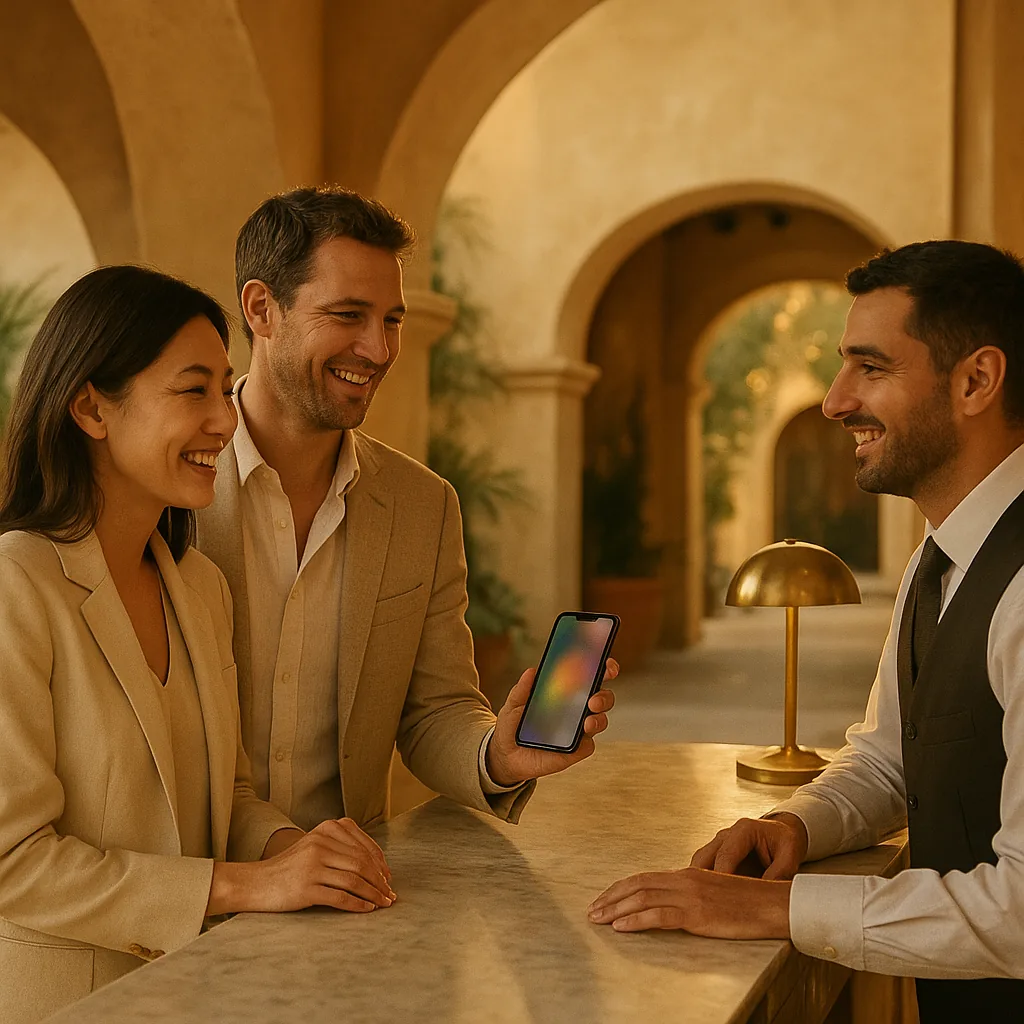
The Scale of International Tourism
The numbers speak for themselves. Tourism is one of the fastest-growing industries globally, and it increasingly reaches beyond capital cities and resort hubs. Boutique hotels in the countryside, lakeside guesthouses, agritourism properties: these places attract international visitors with nature, quiet, and competitive pricing. But their teams are local people who speak the local language and maybe some basic English.
To put it in perspective: Poland's Central Statistical Office reported over 7 million foreign tourists using accommodation in 2023, with the largest groups coming from Germany, Ukraine, the UK, the US, Spain, and Italy. The same pattern repeats everywhere. Spain sees over 85 million international visitors per year. Thailand hosts 28 million. Even smaller markets like Portugal and Greece have seen international arrivals double in the past decade.
In major cities, the situation is manageable. Large hotels have English-speaking staff, sometimes German or French speakers too. But drive an hour outside the city and the picture changes. A mountain lodge, a lakeside pension, a rural retreat. These properties don't have the budget to hire multilingual staff, and they can't compete in the labor market with big-city hotels offering higher salaries. Yet their guests still expect to be understood.
This isn't about people doing a bad job. It's about people facing a task they don't have the tools for.
Where Language Becomes a Problem
Language barriers aren't an abstract concept. They're specific situations that happen in hotels every day.
Ordering food. A guest opens the menu. Everything is in a language they don't read. Local specialties with names that mean absolutely nothing to them. They point at a photo (if there is one) or pick a random item. They get something they didn't want. They don't complain, because they can't. They eat in silence, but next time they order delivery from a food app instead of using the hotel restaurant.
Reporting a problem. The air conditioning isn't working. The guest tries to explain this at reception. "Air... cold... not working." The receptionist understands something is wrong but isn't sure whether it's the heating, the AC, or an open window. They send maintenance, who checks the wrong thing. The problem gets fixed two hours later instead of fifteen minutes.
WiFi instructions. The password is one thing, but the instruction "connect to Hotel-Guest network, open a browser, and accept the terms" in a language the guest doesn't read is a barrier many won't get past. They sit on the bed, use their own mobile data in roaming, and add it to the mental list of "downsides" of the stay.
Local recommendations. "Where's a good place for dinner?" "Is there a hiking trail nearby?" Questions the staff could answer in a second in their own language, but in English they say "sorry, I don't know" instead of "yes, there's a great restaurant 500 meters from here."
Each of these situations on its own is minor. But multiply them across a three-day stay and they create an experience the guest will remember. And describe in a review.
Auto-Translation: What Works and What Doesn't
Let's be honest. Machine translation isn't perfect and it won't replace a native speaker. But in the last three years, the quality has improved dramatically, and it's worth honestly assessing where it works well and where it falls short.
Where it works great: Restaurant menus, service descriptions, hotel information (breakfast hours, house rules, WiFi instructions), local recommendations. These are static texts written in simple language. Modern translation systems handle them well enough that a foreign guest won't notice the difference compared to text written from scratch in their language.
Where it works well: Simple real-time interactions. "I need an extra towel," "What time is breakfast?", "Can I order a taxi for 8 AM?" These types of sentences translate correctly in both directions. The receptionist types in their language, the guest reads it in theirs. Communication works.
Where it has limits: Complex complaints with emotional context. "We were very disappointed because we felt nobody took us seriously after the incident with the broken faucet." Sentences like this can lose their nuance in translation. The same goes for humor, sarcasm, and cultural subtleties.
But here's the key observation: 80-90% of communication between a hotel and its guests consists of simple, predictable exchanges. Questions about hours, requests for services, information about the area. For these interactions, auto-translation is good enough. And for the remaining 10-20%, it's still better than gestures and broken English.
A Chatbot That Speaks the Guest's Language
Picture this. A guest from Spain opens the hotel portal on their phone. They type in Spanish: "Donde se sirve el desayuno?" A second later, they get an answer in Spanish: breakfast hours, restaurant location, information about gluten-free options. They didn't need to find the front desk, didn't need to speak English or the local language.
This isn't science fiction. An AI concierge detects the guest's language automatically and responds in the same language. It works 24 hours a day, 7 days a week. It knows the hotel's menu, house rules, opening hours, information about the area, parking rules, WiFi password. Everything the hotel configures is available in the guest's language.
For simple questions, this solution keeps the guest in their language and inside the hotel portal. The guest doesn't wait in line, doesn't look for someone who speaks their language, doesn't give up on asking because "it's too much hassle."
And what about more complex situations? When a guest needs to talk to a real person, for example to report a serious problem or make a non-standard request, live chat with reception kicks in. The guest writes in their language, the receptionist sees a translation. The receptionist responds in their language, the guest reads it in theirs. It is not perfect, but it gives both sides a clearer path than abandoning the conversation entirely.
The hotel doesn't need to hire someone who speaks Spanish, Italian, and German. It just needs to configure tools that do it automatically.
Multilingual Service Without New Hires
Hiring a receptionist fluent in English and German in a small town isn't just a recruitment challenge. It's a budget challenge. A person with those skills is more likely looking for work in a major city, not at a guesthouse in the countryside. And even if you find them, they cover one shift. For nights and weekends, you need another.
The digital approach looks different. Translate the menu and service descriptions into the configured languages. Configure an AI concierge with hotel data: hours, policies, local area, FAQ. Enable translation on live chat. Timeline depends on how much content needs review, but the work is a focused configuration project rather than a hiring plan. After that, guests using supported languages can open the portal and see hotel content in a language they understand.
I'm not saying technology replaces staff. People still make beds, cook breakfast, and solve problems that require physical presence. But communication, the layer where language barriers hit hardest, can be largely automated.
What does this cost compared to an additional full-time position? A fraction. What does it cover? Common repeat interactions such as menu questions, opening hours, WiFi, directions, and basic policies. Which hotels benefit most? Exactly the smaller, seasonal ones located outside major cities. The ones that attract international guests with nature and atmosphere but don't have the budget for a multilingual team.
Conclusion
Language barriers cost hotels restaurant revenue (guests order less because they can't read the menu), worse reviews (communication frustration ends up on Booking), and missed upsell opportunities (a guest won't book a spa treatment they don't know exists).
Auto-translation tools, multilingual guest portals, and AI concierges don't require a revolution in your team. They require disciplined configuration and review of the content guests actually use. The result: guests using supported languages open their phone and see the hotel in a language they understand. Not perfectly, but well enough to order food, ask a question, and feel taken care of.
International tourism keeps growing year over year. The question isn't "will foreign guests find us," but "will we be ready to serve them when they do."
Sources
- GUS: Tourism in 2023 (Poland Central Statistical Office)Official statistics on international tourism in Poland, including 21.4 million foreign overnight stays in 2023
Written by
Denis Wasilew
Co-founder
Co-founder of Guestivo. Building scalable solutions that empower hotels to deliver outstanding digital guest experiences.
Published: March 3, 2026